
-

5-Amino-1MQ 50mg (60 Capsules)
$179.99 or subscribe for $149.99/mo This product has multiple variants. The options may be chosen on the product page -

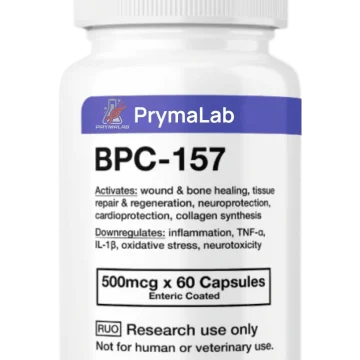
BPC-157 Capsules (60/500mcg)
$129.99 or subscribe for $99.99/mo This product has multiple variants. The options may be chosen on the product page -
Noopept (Omberacetam) 30mg Capsules
$21.99 or subscribe for $18.50/mo This product has multiple variants. The options may be chosen on the product page -
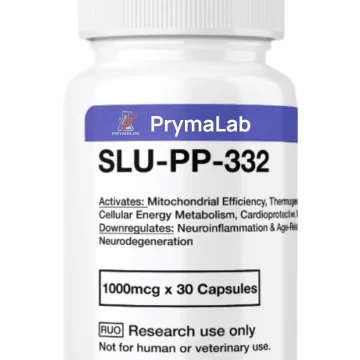
SLU-PP-332 (1000mcg) (30 Capsules)
$139.99 or subscribe for $117.99/mo This product has multiple variants. The options may be chosen on the product page

Three barriers · and which structures actually clear them
Oral peptides face a barrier the vial and the spray do not. A swallowed peptide has to clear gastric acid and pancreatic proteases before it reaches an absorptive surface, and the large majority of sequences clear neither. This page sets out which structures manage it, what fraction realistically arrives, and what a capsule specification has to state.
Specification Table
| Property | Value |
|---|---|
| Format | Encapsulated solid, oral route |
| First barrier | Gastric acid, typically pH 1.5 to 3.5 in the fasted stomach |
| Second barrier | Pancreatic proteases including trypsin, chymotrypsin and elastase |
| Third barrier | Intestinal epithelium, which excludes most molecules above roughly 500 daltons |
| Typical reported oral bioavailability for unmodified peptides | Under 1 percent, frequently far under |
| Structures that resist proteolysis | D-amino acid substitutions, N-methylation, cyclisation, blocked termini, non-coded residues |
| Enteric coating | Addresses the acid barrier only. Does not address proteases or epithelial exclusion |
| Content uniformity | A capsule-specific requirement. Fill weight variation is not visible to the buyer |
| Certificate requirement | Peptide content per capsule, not per gram of blend |
| Page type | Category hub, not a product page |
| Schema page type | CollectionPage |
| Cornerstone content | Yes |
| Meta robots | index, follow |
| Regulatory status | No approved human or veterinary formulation for any compound in this category |
Why Is the Oral Route Hard for Peptides?
Three barriers stand between oral peptides and systemic circulation, and a compound has to clear every one of them.
The first is gastric acid. The fasted stomach sits somewhere between pH 1.5 and 3.5, which hydrolyses susceptible peptide bonds and is particularly harsh on aspartyl-prolyl linkages.
The second is proteolysis. Pancreatic trypsin, chymotrypsin and elastase are secreted into the small intestine specifically to cut peptide bonds, and they are extremely good at it.
Trypsin cleaves after lysine and arginine. Chymotrypsin cleaves after aromatic residues. Between them they cover a large share of possible sequences.
The third is the epithelium itself, which excludes most molecules above roughly 500 daltons from paracellular passage and offers no transporter for arbitrary peptides.
Reported oral bioavailability for unmodified peptides is typically under one percent, and frequently well under.
That is not a formulation problem awaiting a better capsule, and it is the digestive system working as intended on a substrate it evolved to destroy.
A page offering oral peptides without saying so is withholding the single most important fact about the format.
Which Structures Actually Survive?
Some oral peptides do reach circulation intact, and the structural features responsible are well understood.
D-amino acid substitution is the most direct. Proteases evolved on L-amino acid substrates and handle a D residue poorly, so a D substitution at a cleavage site obstructs the enzyme.
N-methylation of the backbone amide removes the hydrogen bond donor that proteases recognise. It also raises membrane permeability, which addresses two barriers at once.
Cyclisation removes free termini entirely, which defeats exopeptidases, and it constrains the backbone so endopeptidases cannot thread it into an active site.
Blocked termini achieve part of the same effect. An N-terminal acetyl or pyroglutamate stops aminopeptidases, and a C-terminal amide stops carboxypeptidases.
Non-coded residues such as Aib obstruct enzymes that have no template for them.
Small size helps independently, since a compound under roughly 500 daltons has a route across the epithelium that a larger one does not.
A sequence carrying none of those features is not a plausible candidate among oral peptides regardless of how it is encapsulated, and that is a structural judgement a buyer can make from the sequence alone.
A caution belongs alongside that list, because the features are necessary rather than sufficient.
A peptide carrying every one of them may still show negligible oral bioavailability, since the three barriers are independent and clearing two does not clear the third.
Structural features predict which oral peptides are worth testing, not which ones will work.
The only thing that settles the question is a measured figure for that specific compound, which for most of this catalogue does not exist.
What Does an Enteric Coating Actually Do?
Enteric coating is the most commonly offered answer to the oral problem. It addresses one barrier of three.
The coating is a polymer that resists dissolution at gastric pH and dissolves at the higher pH of the small intestine.
That protects the contents from acid hydrolysis, which matters materially for an acid-labile compound.
It does nothing about pancreatic proteases, because it releases the contents into exactly the compartment where those proteases are most concentrated.
It does nothing about epithelial exclusion either, since the barrier there is molecular size and permeability rather than chemistry.
So an enteric coating converts a three-barrier problem into a two-barrier problem. That is worth having and is not a solution.
Where a supplier presents enteric coating as making oral peptides viable, the claim outruns what the technology actually does.
The honest version is that it removes the acid barrier and leaves the other two intact, and that is enough for some compounds and not for most.
What Verification Do Peptide Capsules Need?
Peptide capsules introduce a verification requirement that no vial or spray has. It is the one most often missing.
A capsule specification has to state peptide content per capsule, not per gram of the powder blend that was filled into them.
Those are different numbers whenever the fill weight varies, and fill weight always varies to some degree.
Content uniformity is the standard measure, determined by assaying individual capsules rather than a pooled sample.
A pooled assay tells you the average and hides the spread, and the spread is what determines whether any given capsule delivers the labelled amount.
Pharmacopoeial content uniformity limits exist for approved products and are a reasonable benchmark to ask about even where they do not apply.
Beyond that the ordinary peptide questions still apply: measured mass, purity with method stated, sequence, counterion and net peptide content.
Net peptide content matters particularly here, since a capsule fill calculated on gross salt mass overstates delivered peptide by the counterion fraction.
How Do Excipients in Peptide Capsules Change the Picture?
Peptide capsules contain more than peptide, and what else is in them is worth knowing.
Bulking agents make up most of the fill, since research peptide amounts are typically milligrams and a capsule holds hundreds of milligrams.
Microcrystalline cellulose, lactose and magnesium stearate are the common choices, and each has implications.
Lactose is a reducing sugar and can react with lysine side chains through the Maillard reaction over time, which modifies the peptide and is invisible on appearance.
That makes lactose a poor bulking choice for a lysine-containing peptide specifically, and it is a question worth asking.
Magnesium stearate is a lubricant present at low percentage and is generally inert toward peptides.
Moisture in an excipient is the other consideration, since a hygroscopic bulking agent brings water into contact with a peptide that would otherwise be dry.
A full excipient list is therefore not a formality. It determines whether the capsule contents are stable and whether the assay method will work.
How Does the Capsule Compare With Other Formats?
The three formats stocked here suit different situations and the differences are worth making explicit.
A lyophilized vial gives full control. The researcher chooses diluent, volume and concentration, and the material spends only the working period in solution.
A metered spray removes the reconstitution arithmetic and delivers a fixed volume, at the cost of a concentration set by the manufacturer and a delivery route with its own poorly characterised losses.
A capsule removes handling entirely and delivers a fixed amount by a route that most peptides do not survive.
That last clause is the whole trade. Convenience is maximal and delivered fraction is minimal and variable.
For a compound with the structural features described above, the trade may be worth making. For one without them, the capsule is a convenient way to deliver almost nothing.
Deciding which case applies requires looking at the sequence rather than at the format, which is the argument this page is built around.
Where oral bioavailability has actually been measured for a compound, that figure settles the question and should be sought before anything else.
How Do Oral Peptides Compare With Injectable Formats?
The comparison worth making is not one of convenience. It is what fraction of the material reaches circulation, and the gap there is wide enough to change what an experiment is able to conclude.
A subcutaneous injection places the compound below the skin, where it enters circulation through capillary and lymphatic uptake. Reported figures for that route commonly run from fifty percent to near-complete, varying with molecular size.
Oral peptides start somewhere else entirely. Published figures for unmodified sequences sit under one percent, and a good share of the time they sit under a tenth of one percent.
Two orders of magnitude is not a shortfall that a larger fill weight tunes out. It changes which measurements are available at all.
A study reading a plasma concentration curve after oral delivery is frequently working near the lower limit of quantitation of its own assay, which is the region where analytical noise starts to resemble biology.
Variability compounds the problem. Gastric emptying rate, fed or fasted state, and individual protease activity each move the absorbed fraction, and they move it further for oral peptides than for any injected format.
None of that makes oral peptides uninteresting. It places the format in studies designed around it, using a compound selected for protease resistance rather than one chosen first and encapsulated afterwards.
Where a research programme needs a known quantity to arrive in circulation, the oral route is the wrong instrument for the question, and no capsule specification alters that.
What Should Be Asked Before Buying Peptide Capsules?
Five questions cover peptide capsules and none is difficult for a competent supplier.
What is the peptide content per capsule, determined by individual capsule assay rather than by a pooled sample?
What is the full excipient list, including bulking agent, and does it contain a reducing sugar?
Is the capsule enterically coated, and if so is the coating presented as addressing acid alone or claimed to do more?
What is the net peptide content of the material filled, and was the fill calculated on that or on gross weighed mass?
Has oral bioavailability been measured for this compound by anyone, and if so where is the citation?
The last question is the most useful and the least often answered, because for most compounds the answer is that it has not been measured.
A supplier who says so directly is more trustworthy than one who implies otherwise, and that distinction is available from a single exchange.
A note on why the last question matters more than it appears to.
A measured oral bioavailability figure settles everything above it. Without one, the structural argument on this page is the best available reasoning and it remains reasoning.
For most research compounds no such figure exists, and a supplier saying so plainly has given a more useful answer than one implying otherwise.
Where a figure does exist, ask which species it was measured in, since oral absorption differs substantially between rodents and larger animals.
Published Literature
Selected references on oral peptide delivery and the barriers involved.
- Hamman JH, Enslin GM, Kotze AF. Oral delivery of peptide drugs: barriers and developments. BioDrugs. 2005;19(3):165-177. https://doi.org/10.2165/00063030-200519030-00003
- Bruno BJ, Miller GD, Lim CS. Basics and recent advances in peptide and protein drug delivery. Ther Deliv. 2013;4(11):1443-1467. https://doi.org/10.4155/tde.13.104
- Rader AFB, Reichart F, Weinmuller M, Kessler H. Improving oral bioavailability of cyclic peptides by N-methylation. Bioorg Med Chem. 2018;26(10):2766-2773. https://doi.org/10.1016/j.bmc.2017.08.031
Frequently Asked Questions
What are peptide capsules?
Encapsulated solid preparations delivering research compounds by the oral route. Supplied for laboratory research only, and no compound in this category holds an approved formulation anywhere.
Why is the oral route hard for peptides?
Three barriers. Gastric acid at pH 1.5 to 3.5, pancreatic proteases secreted specifically to cut peptide bonds, and an epithelium that excludes most molecules above roughly 500 daltons.
What bioavailability is realistic?
Reported oral bioavailability for unmodified peptides is typically under one percent and frequently far under, and that is the digestive system working as intended rather than a formulation problem awaiting a fix.
Which structures survive?
Those with D-amino acid substitutions, N-methylated backbones, cyclisation, blocked termini or non-coded residues. Small size helps independently, since under roughly 500 daltons an epithelial route exists.
Can that be judged from a sequence?
Largely, yes. A peptide with none of those features is not a plausible oral candidate regardless of how it is encapsulated, and that judgement is available to any buyer who reads the sequence.
What does enteric coating do?
It resists dissolution at gastric pH and dissolves in the small intestine, which removes the acid barrier. It does nothing about proteases or epithelial exclusion.
Is that a solution?
It converts a three-barrier problem into a two-barrier problem. Worth having, and not the same as making a peptide orally viable, which is how it is sometimes presented.
What verification is capsule-specific?
Peptide content per capsule, determined by assaying individual capsules rather than a pooled sample. A pooled assay gives the average and hides the spread, and the spread determines what any given capsule delivers.
Do excipients matter?
Yes. Lactose is a reducing sugar and can react with lysine side chains through the Maillard reaction, modifying the peptide invisibly. That makes it a poor bulking choice for a lysine-containing compound.
How does the format compare with a vial?
A vial gives full control over diluent, volume and concentration. A capsule removes handling entirely and delivers a fixed amount by a route most peptides do not survive. Convenience maximal, delivered fraction minimal.
What is the single most useful question?
Whether oral bioavailability has been measured for the specific compound, and where the citation is. For most compounds it has not, and a supplier who says so directly is more trustworthy than one who implies otherwise.
Should net peptide content be checked here?
Particularly here. A capsule fill calculated on gross salt mass rather than net peptide content overstates the delivered peptide by the counterion fraction, and the buyer cannot see the fill calculation.
What absorbed fraction is realistic for oral peptides?
Published figures for unmodified sequences sit under one percent and frequently under a tenth of one percent. Structural modification changes that. D-amino acid substitution, N-methylation, cyclisation and blocked termini each obstruct a specific class of protease, and a sequence carrying several of them can reach a few percent. Anything above that in a supplier claim warrants a citation.
Do oral peptides need a different certificate from a vial?
Yes. A vial certificate reports purity and identity for the powder as a whole. A capsule certificate has to report peptide content per capsule, because fill weight varies between units and a pooled assay reports the average while concealing the spread. Content uniformity, determined on individual capsules, is the figure that matters here.
Compliance Statement
Peptide capsules are sold exclusively for laboratory research use. They are not a drug, food, or cosmetic product, and they are not a dietary product of any kind. They are not approved by the FDA or any comparable authority for human or veterinary use, no compound in this category holds an approved human or veterinary formulation in any jurisdiction, oral bioavailability for most research peptides has not been measured, and reported figures for unmodified peptides are typically under one percent. These products are not intended to diagnose, treat, cure, or prevent any disease. They must not be given to humans or animals. Purchase is restricted to qualified researchers and institutions operating within applicable laws. All handling is the responsibility of the purchasing laboratory.
All 4 products in the Peptides Capsules range
Every listing states its quantity, concentration and format and carries a batch certificate of analysis. Products are supplied for laboratory research only.